Boat Upholstery Repair: Essential Fixes for Better Center Console Boats
Boat upholstery repair can improve the functionality of center console boats without changing their distinctive open-deck configuration. These vessels feature specialized seating arrangements that accommodate fishing, coastal cruising, and recreational activities. Unlike conventional cabin cruisers, they rely heavily on exposed cushions, padded leaning posts, and integrated seating components. The company Boat Upholstery Fort Lauderdale specializes in marine upholstery and offers restoration services adapted to different boat configurations. Understanding the construction of center console interiors helps owners make practical decisions when individual components begin to deteriorate.
Understand the Construction of Center Console Seating
Center console boats typically feature several independent seating components rather than one continuous furniture arrangement. Depending on the model, these may include forward-facing benches, console seats, leaning posts, folding rear seats, and removable bow cushions.
Each component experiences different types of pressure during regular operation. For example, leaning posts support standing operators, while forward cushions accommodate passengers during recreational outings.
These differences influence how materials deteriorate and which restoration methods specialists should consider. Consequently, boat upholstery repair should address the construction and purpose of each component individually.
Retaining the original seating dimensions also helps preserve the open layout that makes center console boats particularly versatile.
Restore Worn Leaning Posts and Bolsters
Leaning posts represent an important feature of many center console configurations. They provide support for operators and passengers while allowing convenient access to the surrounding deck.
Repeated contact can gradually compress internal padding and weaken coverings around the upper edges. Additionally, decorative seams may separate where the material experiences continuous pressure.
Restoring a leaning post requires attention to its original shape, padding firmness, and attachment system. Excessively soft foam may provide insufficient support, while oversized padding can interfere with comfortable positioning.
During boat upholstery repair, specialists should evaluate how replacement materials affect the original seating profile. Existing dimensions may also determine clearance around rod holders, coolers, or integrated storage compartments.
Improve the Performance of Removable Bow Cushions
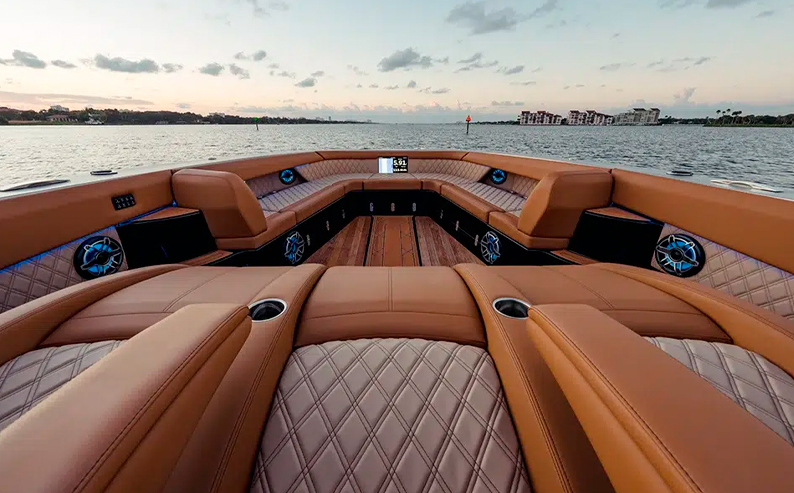
Bow cushions allow many center console boats to transition between fishing and recreational cruising. Owners can remove these components when they need additional working space and reinstall them for passenger comfort.
However, repeated removal and installation can gradually affect cushion edges and attachment points. Poorly fitted replacement covers may also make individual sections difficult to position correctly.
Before arranging boat upholstery repair, examine the following components:
- Cushion backing and supporting materials.
- Snap fasteners and attachment straps.
- Alignment between individual cushion sections.
- Foam condition around frequently compressed edges.
- Drainage features beneath removable seating.
Accurate restoration should maintain the flexibility of the original arrangement. Consequently, new upholstery must fit securely without making cushion removal unnecessarily complicated.
Pay Attention to Folding Rear Seat Mechanisms
Folding rear seats provide additional passenger capacity without permanently occupying valuable deck space. Their compact construction often includes hinges, integrated frames, and cushions that move between different positions.
Replacing upholstery on these components requires careful measurements. Even a relatively small increase in cushion thickness may affect how the seat folds or fits against surrounding surfaces.
Furthermore, damaged coverings around moving sections can experience additional wear whenever passengers operate the mechanism.
A properly planned boat upholstery repair project should preserve the necessary clearance around hinges and attachment points. Owners should also verify that restored seating opens, closes, and locks correctly before returning the vessel to regular use.
Problems involving structural supports or locking mechanisms require appropriate mechanical attention rather than cosmetic upholstery work alone.
Check Drainage Beneath Exposed Seating
Water management deserves particular consideration on boats with open decks. Rain, sea spray, and passengers returning from swimming can introduce moisture around seating components.
Although marine-grade coverings offer suitable protection for many applications, seams and attachment points may still allow moisture to reach internal materials.
During boat upholstery repair, specialists should consider how water moves through and around individual cushions. Replacement foam, backing materials, and cover construction should remain compatible with the original drainage arrangements.
Owners should avoid sealing existing drainage openings simply to achieve a cleaner appearance. Trapped moisture can create additional maintenance problems and contribute to deterioration beneath otherwise attractive coverings.
Decide Which Components Need Complete Restoration
Not every damaged cushion requires identical treatment. Some components may only need replacement coverings, while others require new internal padding or supporting materials.
For instance, a faded console seat with healthy foam may need relatively limited work. However, a heavily compressed leaning post could require more comprehensive restoration.
Owners planning boat upholstery repair can organize the project around three priorities:
- Functional repairs that address deteriorated seating support.
- Protective improvements that resolve damaged coverings and seams.
- Cosmetic updates that improve color consistency and appearance.
Separating these priorities helps establish a realistic maintenance budget. Moreover, documenting existing material specifications can simplify future restoration when additional seating components require attention.
Maintain the Original Versatility of Your Boat
The appeal of a center console boat comes partly from its adaptable configuration. Owners can use the same vessel for fishing, swimming, sightseeing, and social activities.
Interior restoration should support this versatility rather than introduce unnecessary limitations. Secure cushions, accessible equipment, functional folding seats, and suitable materials all contribute to a practical onboard environment.
Professional boat upholstery repair can preserve these characteristics while improving passenger comfort and refreshing worn surfaces.
Ultimately, successful boat upholstery repair depends on understanding how individual seating components interact with the entire vessel. Restoring them according to their original functions helps maintain the performance and convenience that center console owners value.
More interesting articles you can explore here.

Post Comment